
Digital Ecosystem Empowerment for Sustainable Development (DiGEST) for Promoting Climate Change Awareness Project

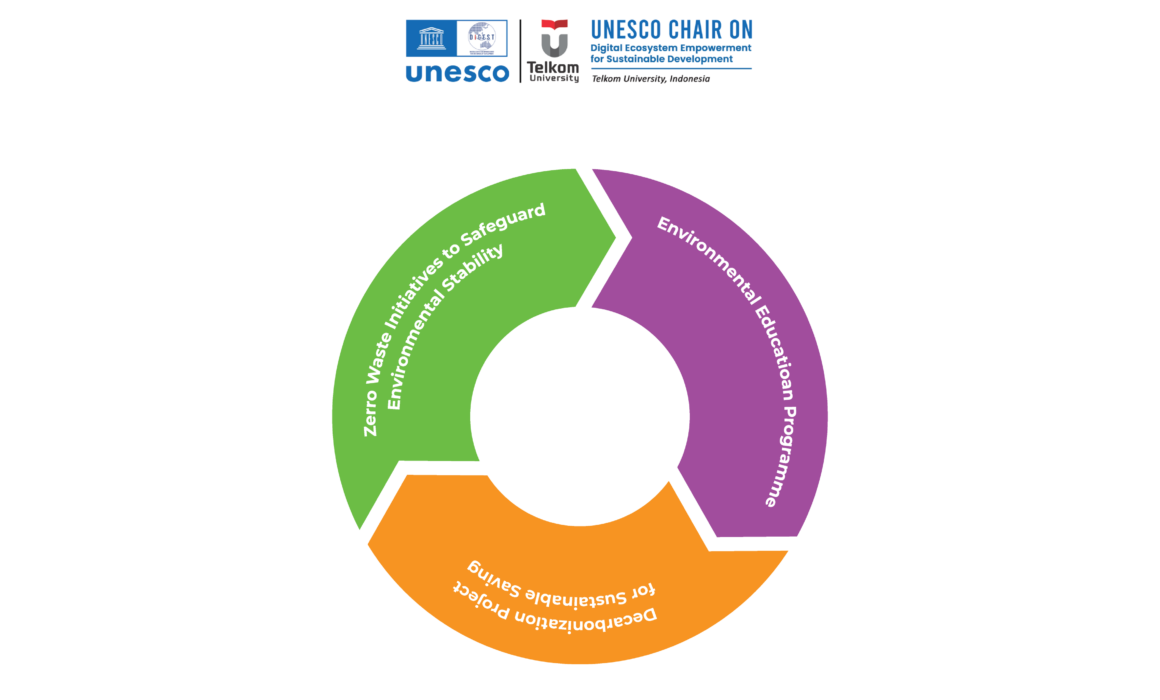
Zero Waste Initiatives to Safeguard Environmental Stability
The project aims to raise awareness about climate change by promoting waste reduction, reuse, and recycling to mitigate its environmental impact, fostering a more sustainable future. Waste is categorized into three main types: organic, non-organic, and hazardous waste. Telkom University currently operates as a Zero Waste University, setting an example by managing its waste internally. Consequently, the initial program as UNESCO Chair seeks to expand the zero-waste initiative to five other underdeveloped villages in the Bandung Area, West Java. The objective is to empower villagers to manage their waste autonomously, relieving environmental burdens and probably providing economic benefits to the community.
- Organic waste
Managing organic waste, such as food and agricultural waste, will include the process of composting and maggot decomposition. Composting entails natural decomposition of organic materials like leaves and paper products in a compost bin. Adjusting moisture and oxygen levels aids decomposition, turning waste into compost. The resulting compost is black, moist, and enriches soil for sustainable farming. Encouraging community adoption of these technologies is important. Additionally, maggots can expedite food waste decomposition. As maggots consume waste, it disappears, fostering their growth, which can be economically beneficial for society if they are sold as animal feed. - Non-organic waste
It is also crucial to address non-recyclable waste like plastic for society. Plastic waste presents numerous challenges due to its non-biodegradable nature, persistent presence in the environment, and potential harm to wildlife and ecosystems. Given its significance as an environmental issue, managing plastic waste has become paramount. Since plastic does not naturally degrade, educating society on waste sorting is essential to prevent discarded plastic products and fragments from polluting the environment, including water bodies, soil, and air. Sorting plastic waste is the initial step in its management process, allowing for potential collection, cleaning and further classification for recycling or resale purposes. - Hazardous waste
Hazardous waste refers to any waste material that poses substantial or potential threats to public health or the environment, usually appears in the form of chemical waste and electronic waste. Due to its potential to cause harm, hazardous waste requires proper and specific handling, storage, transportation, and disposal methods to minimize risks to human health and the environment. Proper management of hazardous waste typically involves stringent regulations and guidelines set by government agencies to ensure safe handling and disposal practices.
On the other hand, the zero-waste program proposed aims to instigate a fundamental change in waste management methods while educating society, guiding it towards a more sustainable, resource-conscious, and environmentally accountable approach that benefits current and future generations.
Portfolio: Zero Waste Initiatives to Safeguard Environmental Stability
Environmental Education Programme
Environmental Education Program integrates curriculum development, sustainable practices, technology use, and waste management education to empower individuals with the knowledge, skills, and attitudes needed to address environmental challenges and promote sustainable living practices. The sustainable practice involves:
- The Green School Initiative strives to foster a sustainable culture within educational institutions, empowering students to develop environmental literacy and responsibility, enabling them to tackle the ecological challenges affecting our planet. Through collaboration with local schools, the program delivers environmental education across various subjects, encompassing themes like climate change, renewable energy, water conservation, and waste management through diverse learning approaches such as classroom instruction, field trips, and practical activities. Moreover, The Green School Initiative emphasizes experiential and practical learning experiences that allow students to engage directly with environmental concepts. This may include activities such as gardening, composting, recycling projects, nature walks, biopores making, and field trips to local conservation areas.
- An Inclusive Educational Digital Platform for Sustainable Development (ARCHIPELAGO) Platform for Climate Change Awareness
The project focuses on the development of digital education platform projects in the form of learning management systems, to advance inclusion and equity in education (particularly for environmental education content), which allow the platform to share its benefit to a broader audience across the globe. It provides new options and contributes to enhancing the quality or efficiency of the education program. Development of a digital education platform with a variety of formal education contents will boost the formal educational & classroom equity, since online platforms enable the academicians to study or even to teach from anywhere and anytime, since the classroom is becoming not the only option to perform formal education. The platform’s infrastructure and services include course development system, learning management system (LMS), open courseware, massive online open course, and live TV. The digital learning platform serves: (1) opportunity for every academician to gain access to a quality education, particularly on environmental education (2) saving the education cost (3) offers a broad education program selection.
Portfolio: Environmental Education Programme
Decarbonization Project for Sustainable Saving
The Decarbonization project consists of multiple activities that aim to deliver a range of outputs nationally, employing interdisciplinary and future-oriented approaches to address key sustainability challenges such as renewable energy projects, electric vehicles, smart farming, and energy-efficient research activities.
- Renewable Energy Initiatives
By scaling up renewable energy projects, related parties can accelerate the transition away from oil & gas usage, reduce greenhouse gas emissions, and advance towards a more sustainable and resilient energy future. In this Renewable Energy Project, outputs include the research and deployment of renewable energy implementation such solar farming systems, or water turbines, the establishment of waste-to-energy plants in 5 (five) different village in West Java, Indonesia. Communication efforts will focus on raising awareness about renewable energy benefits through workshops, engaging local communities in the research process through participatory workshops, community forums to gather input and feedback on renewable energy deployment strategies, and stakeholder engagement for funding purposes. - Electric Vehicle Initiatives
Electric vehicles are one key component of decarbonization strategies in the transportation sector, offering a cleaner and more sustainable alternative to conventional vehicles powered by oil. In the Electric Vehicle (EV) sector, outputs involve the development of EV and its ecosystem including EV charging infrastructures & electric cars. Tasks include conducting surveys, focus groups, site selection for charging stations, partnership development with automotive manufacturers, and interviews to understand community needs and preferences, followed by the installation of EV charging stations in collaboration with local governments and community organizations. Interdisciplinary collaboration between governments, urban designers, and the community to ensure community-driven planning and implementation of EV infrastructure. - Smart Farming Initiatives
Smart Farming initiatives will deliver outputs such as the deployment of IoT sensors, adoption of precision farming techniques, and implementation of data analytics tools to enhance agricultural productivity and sustainability, which support the decarbonization. Activities include field experiments, data collection, and analysis to evaluate the impact of smart farming technologies on crop yields and resource efficiency. Communication efforts will involve farmer workshops, demonstrations, knowledge-sharing workshops, and extension services to disseminate research findings and best practices to local agricultural communities. - Energy Efficiency Initiatives
Energy Efficiency Initiatives will focus on reducing energy consumption and carbon emissions across sectors through a re-engineering process. Telkom University has a long-lasting track record in the field of energy efficiency, particularly in the utilization of technologies such as IoT, Intelligent Energy Management Systems, and Smart Water Monitoring. Tasks encompass identifying energy-saving & monitoring opportunities, and implementation of energy management systems, and interdisciplinary collaboration between engineer teams, and the community. Communication and outreach activities will educate stakeholders about energy-saving practices, and energy workshops, and showcase successful case studies to inspire further action toward decarbonization. Through these integrated efforts, the project aims to accelerate the transition to a low-carbon future while fostering collaboration and innovation across sectors.
Outreach activities for the overall decarbonization project encompass soliciting funding from corporations through corporate social responsibilities, and engaging communities in project implementations. Community involvement ensures project relevance and buy-in. Workshops and forums facilitate dialogue and idea exchange, empowering local stakeholders. Moreover, collaborations with universities enrich research endeavors, pooling expertise, and resources towards sustainable solutions.