
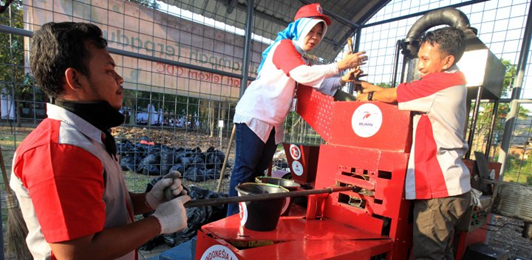
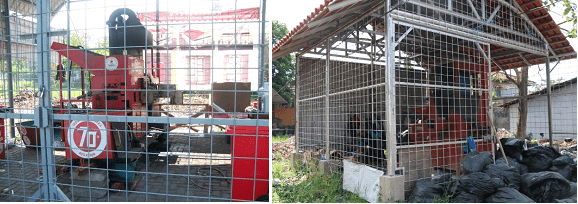
Processing of inorganic waste, especially plastic, is done using a waste burning machine, namely an incinerator. Non-organic waste can be processed using one incinerator machine to reduce volume. This machine operates every day and is operated by two operators. The machine, donated by a state-owned enterprise, runs on a mixture of diesel fuel and water. The output of the processed waste is carbon, which can be used as plant fertilizer. The use of this machine is the last step after various treatments have been carried out.
 |  |  |
| GENERAL SPESIFICATION INCENERATOR | |
| Type | Description |
| Waste | Domestic Waste |
| Combustion capacity | 1000 L/Hour |
| Combustion Chamber Temperature | 600 °C – 1100 °C |
| Ash Percentage | Max ± 5% of Waste volume |
| Dimensions*) tool Combustion chamber | 2250 mm x 1800 mm x 3750 mm 1000 mm x 1000 mm x 1000 mm |
| Material Combustion chamber Wall Plate Refractory Insulation Anti-corrosion coating | Steel Castable concrete Castable concrete Epoxy |
| Burner Burning Chamber Type Quantity | BTP Burner 1 Unit |
| Blower Type | Centrifugal |
| Fuel Requirement*) | 0.5-1.5 Liter/hour (Diesel Oil) 3-6 Liter/hour (water) |
| Fuel Tank Capacity (Diesel and Water) | 20 Liter |
| Required Area | Approx 4 x 4 (m) |
| Quality of Exhaust Gas Emissions | Filter system, Smokeless, Non-Toxin |
| Electricity | 1750 watt |
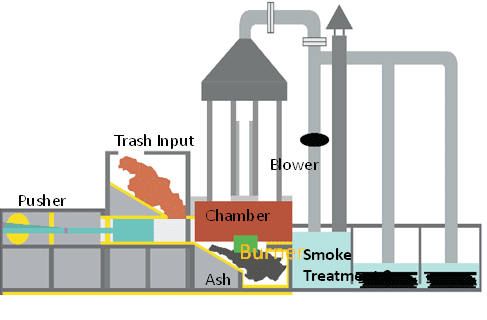
The working principle of the incinerator machine is as follows:
01. Incinerator made by Bandung Techno Park (BTP) with specifications as shown in table.1 currently has a combustion chamber capacity of 1 m3 with a combustion capacity of 1-6 m3 / hour according to the type of waste and moisture content in the waste entered.
02. It is recommended that the waste that enters the incinerator is inorganic waste that no longer has economic value. Waste that enters the incinerator is waste that has been sorted first.
03. Water as an additional fuel when the combustion process has occurred. Water is split into hydrogen using a certain pressure and temperature which is later added to diesel to increase the temperature and heat of the combustion chamber. (Already tested by sucofindo)
04. BTP Incinerator fuel uses Solar as the main fuel and Water as an additional fuel. Diesel consumption is 1-4 liters/hour, while water consumption is 1-12 liters/hour depending on the type of waste that is put in. The wetter the waste, the more wasteful the fuel consumption.
05. Incinerator smoke is safe to be released into the environment, proven by the results of laboratory tests from Sucofindo. The smoke is filtered using 3 times the filtering process before being released into the environment.
06. The incinerator temperature reaches above 1000 oC in open space. In combustion above 800 oC there is no dioxin because it has decomposed into CO2, H2O and HCl (Source: Ministry of Environment).
Of the total inorganic waste of 75kg per day, about 38kg of inorganic waste can be processed by the Incenerator, the rest is disposed of to the TPS.
Leave a Reply