Digital Ecosystem Empowerment for Sustainable Development (DiGEST) for Promoting Climate Change Awareness Project
A. UNESCO PRIORITIES
The Digital Ecosystem Empowerment for Sustainable Development (DiGEST) for Promoting Climate Change Awareness Project initiative aims to create digital environmental ecosystems in response to climate change around the world. The project addresses the consequences of global warming through zero waste program, environmental education program and also decarbonization, as to enhance and minimize the negative impact of climate change on the environment and human activities, thus will guide the humans to work toward a more sustainable and eco-friendly future. The project aligns with UNESCO’s strategic objectives on Outcome 1, Outcome 3, & Outcome 5 and the strategic objectives are further ratified to 3 (three) main programs (The detailed project is explained later in Chapter D). The program mostly involves digitization process in many aspects, particularly in the fields of education, science & engineering, and information technology, where most of the fields mentioned above are aligned with Telkom University’s expertise and UNESCO’s mandate as well. DiGEST Project is also in line with Telkom University’s aspiration to become a World Class Entrepreneurial University in advanced humanity-centric innovations by 2028. Moreover, the theme of digitalization process also contributes to sustainability since digital technology improves the productivity of people’s life with more efficient and effective processes. Affordable digitalization will help the community to engage them in the digital world. Therefore, The DiGEST Project supports the achievement of the Sustainable Development Goals (SDGs) 13 – Climate Action and improves human life, that is in line with UNESCO’s priorities. In essence, the DiGEST Project strives to broaden awareness and address the impacts of global warming, motivating individuals to modify their actions and facilitating adaptation to the urgent global crisis already underway.
B. PROGRAM BACKGROUND
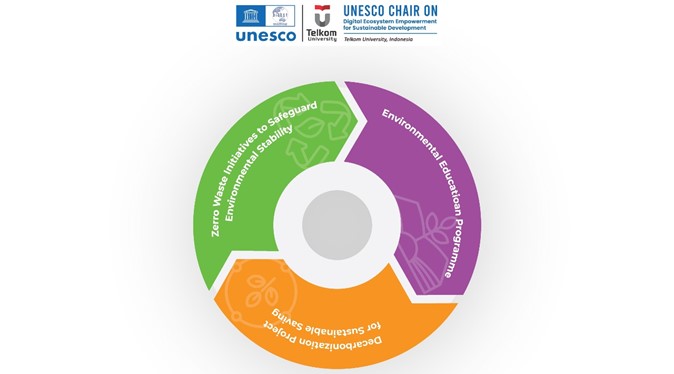
Human activities like burning oil, deforestation, industrial processes, and waste management are the main causes of climate change, leading to adverse effects on both natural ecosystems and human societies. These activities elevate greenhouse gas concentrations in the atmosphere, trapping heat and resulting in global warming, which subsequently alters climate patterns, raises temperatures, and increases the frequency of extreme weather events. Disregarding these issues would pose substantial risks to the environment, economy, public health, and social stability, impacting future generations. To address climate change, urgent and coordinated efforts are needed at local, national, and global levels to reduce emissions, adapt to climate impacts, and enhance resilience in communities and ecosystems. Telkom University, introducing UNESCO Chair on Digital Ecosystem Empowerment for Sustainable Development on Promoting Climate Change Awareness, that consist of 3 (three) main activities: (1) Zero Waste Initiatives, (2) Environmental Education Programme and (3) Decarbonization Project. Through these initiatives, we aim to enhance and minimize the negative impact of climate change on the environment and human activities, thus will guide the humans to work toward a more sustainable and eco-friendly future.
UNESCO Chair on Digital Ecosystem Empowerment for Sustainable Development on Promoting Climate Change Awareness typically focuses on advancing knowledge and promoting education on climate change awareness, through:
- To implement Zero Waste Initiatives Program by promoting reuse and recycling and reducing the ecological footprint of human activities.
- To increase environmental awareness through the Environmental Education Programme.
- To develop and implement a strategy aimed at reducing carbon emissions and promoting sustainable energy practices within the targeted community through Decarbonization Project.