
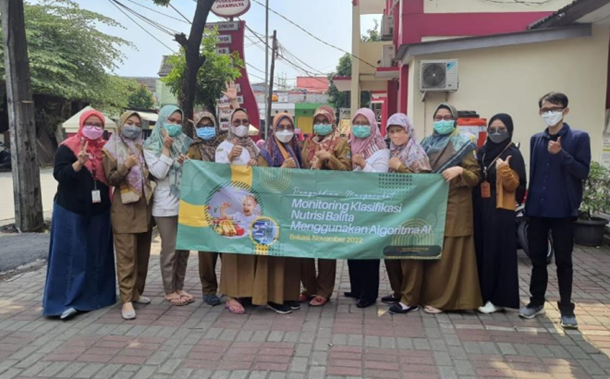
To determine the growth of nutritional status, it is necessary to make observations using anthropometric calculations, which hopefully can provide knowledge to both parents indirectly. There are three anthropometric calculation indices, namely: weight for age (WFA), height for age (HFA), and weight for height (WFH). Therefore, it is necessary to implement an artificial intelligence approach to perform malnutrition-related classifications such as stunting, wasting, controlled nutrition, or malnourished. Not only will this make it easier for parents to know the nutritional status of their toddlers, but also the KIA (Maternal and Child Content) representatives at the Puskesmas can have a system that records, monitors, and classifies nutritional data for toddlers, especially when giving immunizations. This community service in the early stages aims to classify the nutritional status of toddlers based on the anthropometric calculation index using an AI algorithm, namely the Radial Basis Function Neural Network with a total of 358 datasets used. The result obtained from community service using RBF is a classification accuracy of 90% which means that this classification model can be relied upon to monitor whether the nutritional status of a toddler.
Leave a Reply