
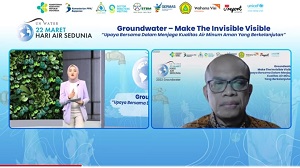
As mandated in the 2020-2024 National Mid-Term Development Plan, the Indonesian government targets 100% access to safe drinking water and 15% access to safe drinking water. Availability of access and ensuring safe and sustainable water quality are human rights and as part of health protection. This was conveyed by Professor of Environmental Engineering Research Center for Limnology & Water Resources – National Research and Innovation Agency (BRIN) and The Executive Director of Asia Pacific Centre for Ecohydrology (APCE), Prof. Dr. Ignatius D.A. Sutapa, M.Sc., at the World Water Day Webinar with the theme Groundwater-make The Invisible Visible with the sub-theme “Maintaining Safe and Sustainable Drinking Water Quality”, on Tuesday (22/3).
Starting his presentation entitled “Profile and Status of Household Drinking Water Quality in 2021″, Ignasius quoted a statement from the 1997-2006 UN General Secretary, Kofi Annan, that drinking water is the right of everyone that must be fulfilled, however, to fulfill it, it turns out that efforts need to be made. many of which are even declared to have won the battle to provide the basic needs of human rights in this world. “The problem related to concern for water is that apart from the existence of springs and groundwater which continues to decrease and land subsidence, environmental pollution is also a problem of quantity and quality of water. One of them is related to inadequate access to sanitation and the practice of disguised defecation behavior by direct disposal, causing microbiological contamination of ground water,” he said.
Furthermore, the figure who serves as Executive Director of APCE – UNESCO C2C stated that several other problems and objectives related to drinking water research include the condition of household drinking water quality greatly affects the level of public health, portraits of districts/cities in achieving accelerated drinking water, and efforts to strengthen supervision. quality of safe drinking water up to the household level, as well as the implementation of Pillar 3 of Community-Based Total Sanitation (STBM) to increase public knowledge and awareness in managing household drinking water. Meanwhile, its purpose is to serve as advocacy material and policy basis for the Central and Regional Governments in improving the drinking water supply and quality system up to the household level or public facilities or workplaces.
The research or survey conducted by his team used sampling in 34 provinces in Indonesia, with various limitations, each province was taken by 34 districts or cities and 824 health centers with a total sample of 9,725 households and a minimum number of respondents more than 200 per regency/city. The method used includes water quality testing parameters, questionnaires and certain observations, so as to obtain profile data and the status of household drinking water quality. To measure the quality profile of drinking water that meets the requirements using 7 parameters including temperature, pH, Nitrate, Nitrite, Chrom valence 6, Coliform, and E-Coli.
Prof. Ignasius conveyed the survey results that from the Profile of Household Drinking Water Facilities (SAMRT) there are 14 types: including dug wells, springs, rain shelters, surface water, water terminals, refill water, bottled water and others, so it is necessary to simplify and standardize . The 3 main drinking water facilities that are widely used are refill water, protected dug wells and piped water. The level of risk of piped drinking water facilities on the quality of drinking water shows a low to moderate risk. High and very high risks were found in the districts of the Tanimbar Islands and East Kutai.
“The risk level of piped SAM pollution on drinking water quality has a low and moderate risk on average, but in Manokwari Regency it has a fairly large risk with the highest value of 26.7%,” said Ignasius. “The drinking water quality profile based on 7 interesting parameters is for the E. Coli and Total Coliform parameters, which is a challenge that must be faced together, because the sampling point that meets the requirements is still relatively low,” he added.
He detailed that the survey results show that there are still people who use the main drinking water sources other than pipes and drinking water depots. A total of 15.9% used protected dug wells, 3.8% used unprotected dug wells, 14.1% used drilled/pump wells, 4.2% used protected springs, 2.5% used unprotected springs, 1 .4% use water purchased retail and 0.3% use water terminals. “It is estimated that 14.8% of households in Indonesia use dug wells for drinking purposes with a high and very high level of contamination risk,” he explained.
Furthermore, the level of access to bottled drinking water for people in Indonesia shows a fairly large portion, and is significant with the level of access to drinking water being quite safe. Three important factors to support the availability of household drinking water are education and literacy for the community, water security system from source to community, and monitoring/supervision.
As Deputy Chair of the Expert Committee on Environmental Health Problems (KOMLI Kesling) – Ministry of Health of the Republic of Indonesia, Ignas, who is also the discussion team of the surveillance results of the Directorate of Environmental Health – Ministry of Health, RI, ended the presentation by conveying conclusions and recommendations that in Indonesia there are 14 types of household drinking water facilities. , so it is necessary to simplify and standardize. The level of access to safe drinking water for households is in the range of 20.4% if bottled drinking water (AMDK) and refill drinking water depots (Damiu) are included in the calculation. Meanwhile, the existence of E-Coli and Total Coliform is still a major challenge to be overcome in an effort to ensure safe drinking water quality. Increasing public literacy and education related to drinking water facilities as well as the implementation of the five STBM pillars are important aspects that need to be carried out in addition to strengthening internal and external supervision by implementing risk-based management surveillance.
For information, World Water Day, which is commemorated every March 22 every year, is a form of warning to the entire world community to always make efforts to conserve water resources. “Groundwater: Making the invisible visible” has been appointed by the United Nations (UN) as this year’s theme. Among them, groundwater is the focus this year, although it is not visible, its benefits are very useful for life.
In accordance with the purpose of the webinar activity, namely to disseminate water health policies, portrait water quality and information education in maintaining the quality of safe drinking water in a sustainable manner. In this webinar consisting of 3 sessions, the speakers were officials and regional heads as well as qualified and competent personnel in their fields, including speakers from BRIN.
Leave a Reply